
When organizations evaluate migrating from SAS to Python, the conversation inevitably turns to cost. How much will it cost to migrate? How long until we see returns? What is the total cost of ownership? These are the right questions, and the answers strongly favor automated migration over manual approaches.
In this article, we break down the full financial picture of SAS-to-Python migration, including licensing savings, labor costs, error reduction, and productivity gains. We present concrete ROI calculations and a framework you can use to build your own business case.
The SAS Licensing Cost Burden
SAS licensing is the most visible cost driver and often the initial motivation for migration. SAS operates on an annual subscription model, and costs vary significantly based on the products, number of users, and data volumes. However, industry benchmarks provide clear ranges:
| Organization Size | Typical Annual SAS License | Includes |
|---|---|---|
| Small (50-200 users) | $500K - $1.5M | Base SAS, SAS/STAT, Enterprise Guide |
| Mid-size (200-1,000 users) | $1.5M - $5M | Above + SAS/ACCESS, Enterprise Miner, Visual Analytics |
| Large (1,000+ users) | $5M - $20M+ | Full platform including Grid, Viya, Risk modules |
These are recurring annual costs. Over a five-year period, a mid-size organization spends $7.5M to $25M on SAS licensing alone. Python, by contrast, is free and open-source. The infrastructure to run Python -- cloud compute on AWS, Azure, or GCP, or platforms like Databricks and Snowflake -- does carry costs, but these are typically 60 to 80 percent lower than equivalent SAS licensing.
Five-Year Licensing Comparison
A mid-size financial services firm spending $3M annually on SAS licenses would spend $15M over five years. After migration, their Python-based cloud analytics infrastructure costs approximately $600K annually, or $3M over five years. The net saving is $12M, which alone justifies most migration projects.

SAS to Python migration — automated end-to-end by MigryX
The True Cost of Manual Migration
The most common mistake organizations make is underestimating the cost of manual migration. On paper, it seems straightforward: hire developers, convert the code, test it. In practice, manual migration is far more expensive than most initial estimates.
Labor Costs
Manual SAS-to-Python conversion requires developers who understand both SAS and Python deeply. These dual-skilled professionals command premium rates. Based on industry data:
- Fully loaded cost per developer: $150,000 to $250,000 annually (salary, benefits, overhead)
- Average conversion rate: 3 to 5 SAS programs per developer per week (including analysis, conversion, testing, and debugging)
- Average enterprise codebase: 5,000 to 50,000 SAS programs
For a codebase of 15,000 programs, at 4 programs per developer per week, you need approximately 3,750 developer-weeks of effort. With a team of 15 developers, that translates to 250 weeks -- nearly five years. At $200,000 per developer annually, the labor cost alone is $15M over the project duration.
Hidden Costs of Manual Migration
Labor is just the beginning. Manual migration carries significant hidden costs that often double or triple the initial estimate:
- Project management: A five-year migration project requires dedicated project managers, business analysts, and coordinators. Add 15-20% overhead.
- Rework and defects: Manual conversion typically has a 5-15% defect rate. Each defect requires diagnosis, fix, and re-testing. Budget 20-30% additional for rework.
- Parallel running: During migration, you must maintain both SAS and Python environments. SAS licenses continue during the transition.
- Knowledge transfer: When developers leave during a multi-year project, their context leaves with them. Onboarding replacements adds months of delay.
- Opportunity cost: Every month spent migrating is a month your analytics team is not building new capabilities.
MigryX: Purpose-Built for Enterprise SAS Migration
MigryX was designed from the ground up for enterprise SAS migration. Its SAS parser understands every construct — DATA steps, PROC SQL, PROC SORT, PROC MEANS, PROC FREQ, PROC TRANSPOSE, macros, formats, informats, hash objects, arrays, ODS output, and even SAS/STAT procedures like PROC REG and PROC LOGISTIC. This is not a generic code translator — it is the most comprehensive SAS migration platform in the industry.
The Economics of Automated Migration
Automated migration fundamentally changes the cost equation by replacing the most labor-intensive parts of the process with software.
Speed of Conversion
Automated translation engines process SAS code at machine speed. What takes a developer a week to convert manually, an automated tool can process in minutes. The human role shifts from writing code to reviewing and validating the automatically generated output.
For the same 15,000-program codebase:
| Phase | Manual Approach | Automated Approach |
|---|---|---|
| Code inventory and analysis | 8-12 weeks | 1-2 days |
| Code conversion | 200-250 weeks (team of 15) | 2-4 weeks |
| Review and refinement | Included above | 8-12 weeks (team of 8) |
| Testing and validation | 60-80 weeks | 4-6 weeks (automated) |
| Total timeline | 3-5 years | 4-6 months |
| Total labor cost | $10M - $20M | $800K - $2M |
| Tool/platform cost | N/A | $300K - $800K |
| Total migration cost | $10M - $20M | $1.1M - $2.8M |
Error Reduction
Automated tools apply conversion rules consistently. The same SAS pattern is always translated the same way, eliminating the inconsistency that plagues manual conversion. This consistency reduces defect rates from 5-15% to under 2%, which translates directly to lower testing costs and faster production readiness.
Built-In Validation
Testing is often the most expensive phase of manual migration because it requires running SAS and Python code side by side and comparing outputs. Automated platforms generate validation frameworks alongside the converted code, automating this comparison and producing audit-ready reports. This alone can save 40-60% of the testing budget.
ROI Calculation Framework
To build a business case for automated migration, consider these four cost categories over a five-year horizon:
1. Licensing Savings (Recurring)
Calculate your current annual SAS license cost and subtract the projected annual cost of your target Python/cloud infrastructure. This savings recurs every year after migration is complete.
2. Migration Cost (One-Time)
The cost of the migration project itself, including tool licensing, labor for review and validation, and project management. With automation, this is typically 70-85% less than manual migration.
3. Productivity Gains (Recurring)
After migration, teams using Python on modern cloud platforms typically report 20-40% productivity improvements due to faster development cycles, better tooling, and access to modern libraries. Quantify this by estimating hours saved per analyst per week.
4. Talent Cost Reduction (Recurring)
Python developers are more available and often less expensive than SAS specialists. The broader talent pool reduces recruiting costs and time-to-fill for open positions.
Sample ROI Calculation
Organization: Mid-size bank, 500 analysts, 12,000 SAS programs
Current annual SAS cost: $4M
Migration cost (automated): $1.8M (one-time)
Post-migration annual infrastructure: $900K
Annual savings: $3.1M ($4M - $900K)
Break-even: 7 months after migration completion
Five-year net savings: $13.7M ($3.1M x 5 years - $1.8M migration)
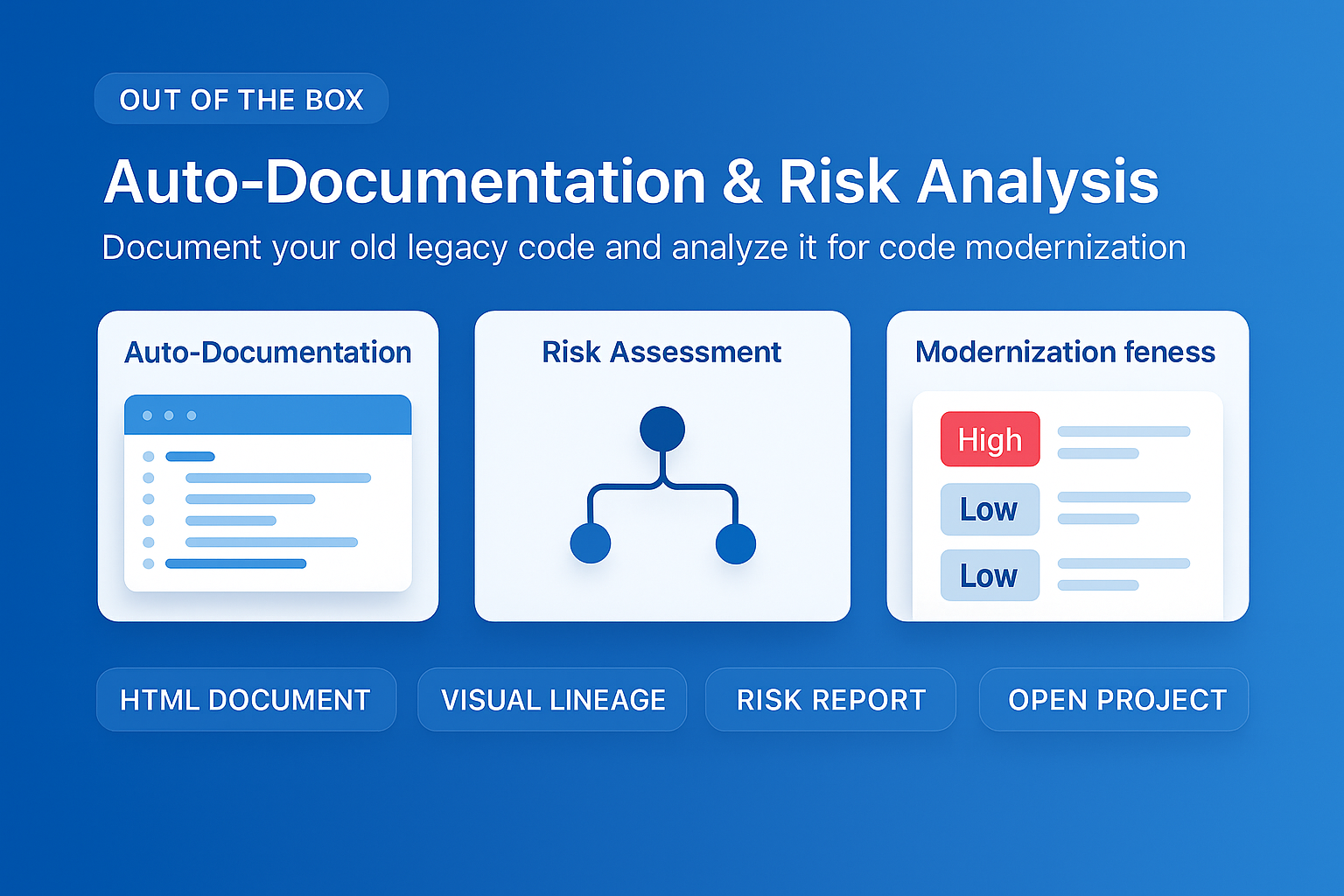
MigryX auto-documentation captures every transformation decision, creating audit-ready migration records automatically
How MigryX Handles the Hard Parts of SAS Migration
Every SAS shop has code that makes migration teams nervous — deeply nested macros that generate dynamic code, DATA step merge logic with complex BY-group processing, hash object lookups, RETAIN statements that carry state across rows, and PROC IML matrix operations. These are exactly the constructs where MigryX excels. Its combination of deterministic AST parsing and Merlin AI means even the most complex SAS patterns are converted accurately.
Break-Even Analysis
The break-even point for automated migration is remarkably fast. Because the migration project itself is completed in months rather than years, organizations stop paying SAS licenses much sooner, and the cumulative savings begin accruing immediately.
In the example above, the organization completes migration in six months. During those six months, they pay both SAS licenses and migration costs. Starting in month seven, the SAS license is eliminated. By month thirteen, the total savings have exceeded the migration investment.
Compare this to manual migration: a three-to-five-year project means three to five years of continuing SAS license payments before any savings are realized. The total cost of the manual approach (migration labor plus continued licensing) can be three to five times higher than the automated approach.
Beyond Direct Cost Savings
The financial benefits extend beyond what appears on a spreadsheet:
- Speed to innovation: Teams freed from SAS migration work can focus on building new ML models, real-time analytics, and customer-facing data products.
- Cloud elasticity: Pay only for the compute you use, rather than sizing SAS infrastructure for peak loads that occur a few days per month.
- Ecosystem leverage: Access to the entire Python ecosystem means you can adopt new techniques like large language models, graph analytics, or streaming without waiting for a vendor to add support.
- Reduced vendor risk: Diversifying away from a single vendor reduces strategic risk and strengthens your negotiating position with all technology partners.
The question is not whether you can afford to automate your SAS migration. The question is whether you can afford not to, given the compounding cost of SAS licensing and the accelerating pace of analytics innovation in the Python ecosystem.
Making the Business Case
To secure executive approval for automated migration, present the financials in terms your CFO understands: total cost of ownership over five years, payback period, internal rate of return, and risk-adjusted net present value. The numbers consistently favor automation, often by an order of magnitude.
Start with a pilot. Most automated migration platforms offer an assessment phase where a sample of your SAS codebase is analyzed and converted, providing concrete data on conversion rates, quality, and projected timelines. This pilot data transforms the business case from theoretical estimates to evidence-based projections.
Why Every SAS Migration Needs MigryX
The challenges described throughout this article are exactly what MigryX was built to solve. Here is how MigryX transforms this process:
- Complete SAS coverage: MigryX handles every SAS construct — DATA steps, PROC SQL, macros, formats, hash objects, arrays, ODS, and 20+ PROCs.
- 4-8x faster than manual: What takes consulting teams months of manual conversion, MigryX accomplishes in weeks with higher accuracy.
- 60-85% cost reduction: Enterprises report dramatic cost savings compared to manual migration approaches.
- Production-ready output: MigryX generates clean, idiomatic Python, PySpark, Snowpark, or SQL — not rough drafts that need extensive rework.
MigryX combines precision AST parsing with Merlin AI to deliver 99% accurate, production-ready migration — turning what used to be a multi-year manual effort into a streamlined, validated process. See it in action.
Ready to modernize your legacy code?
See how MigryX automates migration with precision, speed, and trust.
Schedule a Demo