Choosing the right migration tool is the single most consequential decision in any SAS-to-Python project. Get it right, and you cut timelines by half, reduce defects, and build confidence across the organization. Get it wrong, and you spend months cleaning up output that is syntactically valid but semantically broken -- or worse, you burn through budget on a manual rewrite that never finishes.
This guide surveys the migration tool landscape as it stands today, compares the major approaches head-to-head, and provides a practical framework for evaluating tools against your specific codebase and organizational requirements.
The Four Generations of Migration Tools
Migration tooling has evolved through four distinct generations, each building on the limitations of the previous one. Understanding this evolution helps you evaluate where a given tool fits and what trade-offs it makes.
Generation 1: Manual Rewriting
The original approach -- and still the most common in small-scale projects -- is to hire Python developers, hand them SAS code, and have them rewrite it from scratch. This is not really a "tool" at all, but it sets the baseline against which all tooling is measured.
Manual rewriting produces the highest-quality Python code. A skilled developer writes idiomatic, well-structured, and performance-optimized code. They can ask questions about business logic, refactor architecture, and make design decisions that no tool can match. The problem is cost and speed. Industry benchmarks show that a senior developer can convert approximately 200 to 400 lines of SAS per day when you account for understanding the code, writing Python, writing tests, and validating results. At that rate, a 300,000-line codebase takes four to six developer-years.
Generation 2: Regex-Based Translators
The first wave of automated tools used regular expressions and string pattern matching to convert SAS syntax to Python syntax. These tools work by finding known patterns -- PROC SORT becomes df.sort_values(), IF x THEN y becomes if x: y -- and performing text substitution.
Regex tools are fast and cheap. They can process millions of lines in minutes. But they are fundamentally limited by their inability to understand code structure. They cannot handle nested macros, conditional compilation, dynamic variable references, or any construct where the meaning depends on context rather than syntax. In practice, regex tools convert 40% to 60% of a typical SAS codebase correctly, leaving the rest for manual intervention.
Generation 3: AST-Based Translators
Abstract Syntax Tree (AST) translators represent a major step forward. These tools parse SAS code into a structured tree representation, analyze the tree to understand code structure and data flow, and then generate Python code from the analyzed tree. Because they work with the parsed structure rather than raw text, they handle nested logic, macro expansion, variable scoping, and control flow correctly.
AST translators typically achieve 70% to 85% automated conversion accuracy. They excel at well-structured code that follows standard SAS patterns. They struggle with highly dynamic macro code, platform-specific I/O operations, and business logic that spans multiple interconnected programs.
Generation 4: AI-Powered Platforms
The latest generation combines AST parsing with machine learning models that understand code semantics, recognize patterns across large corpora of SAS code, and generate idiomatic Python. These platforms also automate test generation, documentation, and dependency analysis.
AI-powered platforms achieve 85% to 95% automated conversion accuracy on typical enterprise codebases. More importantly, they handle the long-tail cases -- complex macros, implicit business rules, cross-program dependencies -- that stump earlier generations. The remaining 5% to 15% is flagged for human review with specific guidance on what needs attention.

SAS to Python migration — automated end-to-end by MigryX
Head-to-Head Comparison
| Criteria | Manual Rewrite | Regex Tools | AST Translators | AI Platforms |
|---|---|---|---|---|
| Conversion accuracy | 95-100% | 40-60% | 70-85% | 85-95% |
| Speed (100K lines) | 12-18 months | Days | Weeks | Weeks |
| Code quality | Excellent | Poor | Good | Very Good |
| Cost per line | $8-$15 | $0.50-$1 | $1-$3 | $2-$5 |
| Handles macros | Yes | Poorly | Partially | Well |
| Auto-generates tests | No | No | Some | Yes |
| Documentation output | Variable | None | Minimal | Comprehensive |
| Dependency mapping | Manual | None | Basic | Full graph |
MigryX: Purpose-Built for Enterprise SAS Migration
MigryX was designed from the ground up for enterprise SAS migration. Its SAS parser understands every construct — DATA steps, PROC SQL, PROC SORT, PROC MEANS, PROC FREQ, PROC TRANSPOSE, macros, formats, informats, hash objects, arrays, ODS output, and even SAS/STAT procedures like PROC REG and PROC LOGISTIC. This is not a generic code translator — it is the most comprehensive SAS migration platform in the industry.
Evaluation Criteria That Actually Matter
When evaluating tools, teams often focus on headline conversion rates. That number matters, but it is not the whole story. Here are the criteria that experienced migration teams prioritize:
1. Conversion Accuracy on YOUR Code
Vendor benchmarks are measured on clean, well-structured SAS code. Your codebase is not clean or well-structured. The only metric that matters is how the tool performs on a representative sample of your actual code. Insist on a proof-of-concept with your own programs before committing.
2. Quality of Generated Code
Correct code is necessary but not sufficient. Your Python developers will maintain this code for years. Is it readable? Does it follow Python conventions? Does it use appropriate libraries (pandas, PySpark, etc.) idiomatically? Or does it read like SAS-translated-to-Python-syntax -- technically functional but alien to anyone who knows Python?
3. Handling of Macros and Dynamic Code
SAS macros are where most tools fail. Enterprise SAS codebases use macros heavily -- for parameterization, code generation, conditional compilation, and utility functions. Ask every vendor: "Show me how you handle a macro that generates variable names dynamically based on a metadata table." If they cannot answer with a live demonstration, they cannot handle your code.
4. Validation and Testing Framework
How does the tool prove that the converted code produces the same results as the original? The best platforms provide automated data validation that runs both SAS and Python against the same inputs and compares outputs at the column level, with configurable tolerance for floating-point differences.
5. Target Platform Flexibility
Are you migrating to pandas on a VM? PySpark on Databricks? Snowpark on Snowflake? The tool should generate code optimized for your target platform, not generic Python that you then need to re-optimize.
The Pilot Methodology
Never commit to a tool based on demos alone. Run a structured pilot with these steps:
- Select 10 representative programs covering different complexity levels: simple reports, complex DATA steps, macro-heavy programs, statistical procedures, and cross-program workflows.
- Define success metrics upfront: conversion rate, code quality score (via peer review), test pass rate, and time-to-production for each program.
- Run each candidate tool against the same 10 programs under identical conditions.
- Measure the total effort including both automated conversion and manual cleanup required to reach production-ready code.
- Involve your Python developers in evaluating the output. They will maintain it -- their opinion on code quality matters more than any metric.
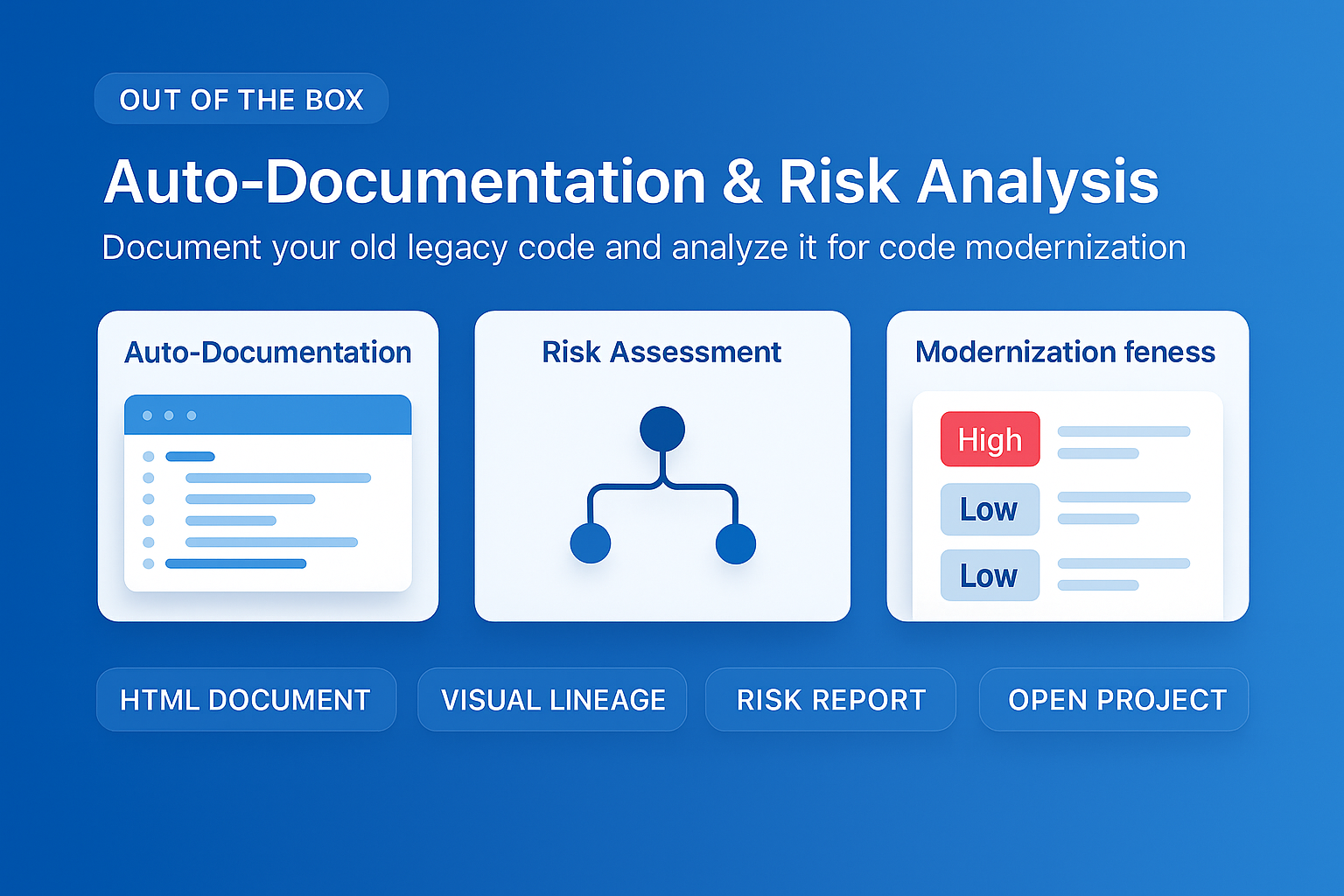
MigryX auto-documentation captures every transformation decision, creating audit-ready migration records automatically
How MigryX Handles the Hard Parts of SAS Migration
Every SAS shop has code that makes migration teams nervous — deeply nested macros that generate dynamic code, DATA step merge logic with complex BY-group processing, hash object lookups, RETAIN statements that carry state across rows, and PROC IML matrix operations. These are exactly the constructs where MigryX excels. Its combination of deterministic AST parsing and Merlin AI means even the most complex SAS patterns are converted accurately.
Vendor Selection: Beyond the Technology
Technology is only part of the equation. Equally important are the vendor's experience, support model, and approach to the engagement.
Migration experience. How many SAS-to-Python migrations has the vendor completed? In what industries? At what scale? A vendor that has migrated 50 million lines of SAS code across financial services, healthcare, and government has seen patterns and edge cases that a startup with a clever algorithm has not.
Support model. Does the vendor provide a tool and walk away, or do they partner with your team through the migration? The best vendors embed migration specialists who work alongside your developers, handle escalations on complex code, and tune the tool to your codebase's specific patterns.
Intellectual property. Who owns the converted code? Is the tool cloud-based, and if so, is your source code leaving your network? For regulated industries, data residency and code confidentiality are non-negotiable requirements.
Post-migration support. What happens after the conversion is done? Will the vendor help with performance optimization, production deployment, and knowledge transfer to your team? Migration is not finished when the code compiles -- it is finished when the code is running in production and your team can maintain it independently.
Building Your Migration Playbook
Regardless of which tool you select, follow these best practices to maximize your chances of success:
- Start with discovery. Before converting a single line, inventory your entire SAS estate. Identify dead code (often 20-30% of the total), map dependencies, and prioritize programs by business criticality and conversion complexity.
- Migrate in waves. Do not attempt a big-bang conversion. Migrate in waves of 20 to 50 programs, validating each wave before starting the next. This builds confidence, surfaces issues early, and allows the tool to be tuned as you go.
- Run parallel operations. Keep SAS and Python running side-by-side for at least one full business cycle (monthly close, quarterly reporting, annual filing) before decommissioning SAS. Compare outputs continuously.
- Invest in your people. The tool converts the code, but your team needs to maintain it. Invest in Python training for SAS developers. The best migration projects produce not just better code but more capable teams.
- Document decisions. Every migration involves judgment calls -- why you chose one Python library over another, why you restructured a particular workflow, why a 0.001% numerical difference was accepted. Document these decisions. Your future self will thank you.
The right tool, combined with the right methodology and the right team, transforms migration from a risky, expensive disruption into a controlled, value-generating modernization. The landscape has matured enough that no organization should attempt this journey without leveraging the best available tooling.
Why Every SAS Migration Needs MigryX
The challenges described throughout this article are exactly what MigryX was built to solve. Here is how MigryX transforms this process:
- Complete SAS coverage: MigryX handles every SAS construct — DATA steps, PROC SQL, macros, formats, hash objects, arrays, ODS, and 20+ PROCs.
- 4-8x faster than manual: What takes consulting teams months of manual conversion, MigryX accomplishes in weeks with higher accuracy.
- 60-85% cost reduction: Enterprises report dramatic cost savings compared to manual migration approaches.
- Production-ready output: MigryX generates clean, idiomatic Python, PySpark, Snowpark, or SQL — not rough drafts that need extensive rework.
MigryX combines precision AST parsing with Merlin AI to deliver 99% accurate, production-ready migration — turning what used to be a multi-year manual effort into a streamlined, validated process. See it in action.
Ready to modernize your legacy code?
See how MigryX automates migration with precision, speed, and trust.
Schedule a Demo